We'd like to hear from you.
Phone line
Mon to Fri 8:00am-4:00pm
Working hours
451 Atkinson Dr
Honolulu, HI 96814
Honolulu, HI 96814
Visit us
News
General Trades Delegates Gather to Build Strategy, Solidarity, and Strength
August 16, 2026
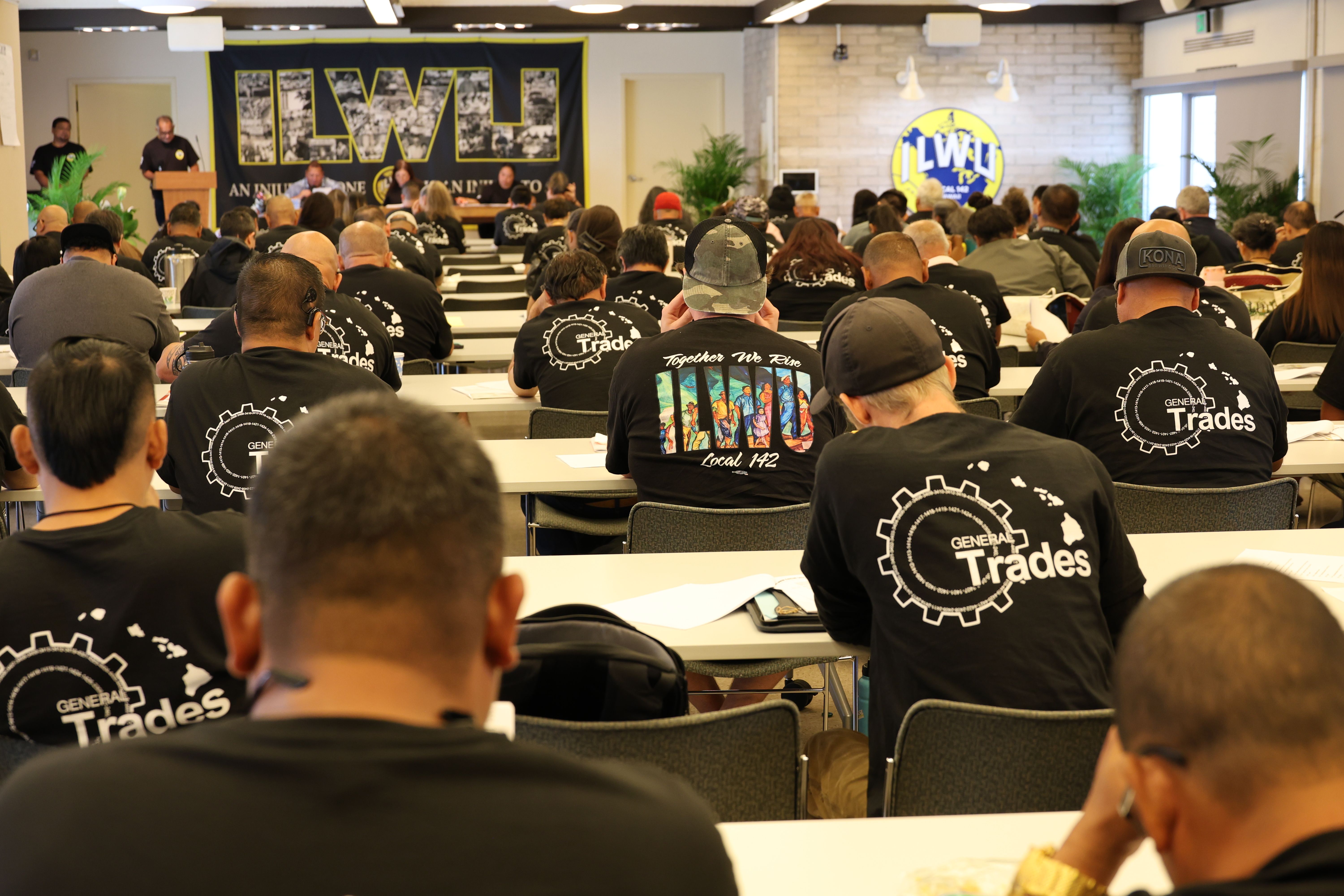
For two days in May, elected delegates from across Hawaiʻi gathered at the ILWU Local 142 hall in Honolulu to take on a critical task: preparing the General Trades industry for the challenges ahead. Held May 13-14, the General Trades Caucus brought together 83 delegates representing every island and every major sub-industry within the General Trades grouping, including automotive and mechanics, agriculture, grocery, healthcare, landscaping and maintenance, and trucking and warehouse.
Industrial caucuses are designed to help members identify shared contract priorities, develop bargaining strategies, and strengthen coordination across units and islands. For many delegates, the caucus was also an opportunity to build relationships with fellow workers facing similar challenges in very different workplaces.
The caucus marked the first General Trades Caucus since 2011 and the second industrial caucus held under the current administration of the union’s top officers. Local 142 leadership has emphasized that industrial caucuses will remain a regular feature moving forward as part of a broader effort to strengthen member participation and long-term industry strategy. “This union is strongest when members themselves are shaping the direction of bargaining and strategy,” said ILWU Local 142 President Chris West. “The caucus gives workers the opportunity to step back from the day-to-day issues of their individual shops and look at the bigger picture together — where the industry is heading, what employers are preparing for, and how we build the kind of unity needed to protect working people in the years ahead.”
The first day focused on education and preparation, while the second day of the caucus focused on action and decision-making. Delegates began by learning about the current health and status of the ILWU Health and Welfare Fund and Pension Trust programs, helping members better understand the protections they fight to maintain through bargaining. Local 142’s General Counsel then presented on the “do’s and don’ts” of negotiations, walking delegates through the legal framework surrounding bargaining campaigns.
The presentation focused on what employers can and cannot do during negotiations, while also emphasizing how workers can organize boldly, visibly, and strategically within the protections of labor law.
Following lunch, delegates turned their attention toward one of the most rapidly emerging challenges facing workers today: artificial intelligence.
Researcher and educator Olin Lagon delivered a guest presentation examining the rapid growth of A.I. technologies and the ways employers are increasingly using them in workplaces. Lagon argued that many white-collar and computer-based jobs may face significant disruption first, but warned that the use of A.I. for worker surveillance, productivity tracking, and discipline is already expanding across industries.
He also outlined examples of contract language unions around the country are beginning to explore in order to protect workers from job loss, technological displacement, and invasive monitoring systems.
For many delegates, the presentation on A.I. was one of the most eye-opening sessions of the caucus.
“I came in thinking A.I. was mostly something affecting office jobs or tech workers,” said one delegate from the grocery industry. “But hearing how companies can use technology to monitor workers, track productivity, and even reduce staffing made me realize this is something every union member needs to understand.” The first day concluded with a mobilizing training focused on member engagement, internal organizing, and building unity during contract campaigns.
By the second morning, delegates shifted from learning to strategy-building. Local 142 Vice President Corinna Salmo-Nguyen and Contract Administrator Michelle Tran presented a series of priority Local-wide bargaining proposals. These included contract language for union access rights, protections for workers and union contracts during company sales or ownership changes, and language related to A.I. and technology.
Delegates then broke into sub-industry groups to discuss the specific issues facing their sectors. Members shared workplace concerns, identified common challenges across islands and employers, and narrowed their discussions into top bargaining priorities for their industries.
Before the close of the morning session, delegates reconvened and unanimously adopted the Local-wide proposals.
The afternoon focused on negotiation strategy, proposal writing, and continued industry breakout discussions. Business Agents were distributed throughout the caucus groups to facilitate discussion and help members think through bargaining strategy and industry coordination.
But the process was not simply instructional. Business Agents also used the caucus to better understand how workplace issues are developing across entire industries.
“As Business Agents, we’re often dealing with issues unit by unit,” said Maui Business Agent, Jackie Tavares. “The caucus helps us zoom out and hear patterns developing across multiple workplaces and islands. It helps us understand what members are experiencing in real time and where we need to focus our energy moving forward.”
Delegates repeatedly emphasized the value of hearing from workers outside of their own units and industries.
Evaluation feedback gathered at the conclusion of the caucus reflected strong enthusiasm for both the educational offerings and the collaborative structure of the event. Delegates highlighted the value of learning across industries, strengthening solidarity, and preparing for future bargaining challenges. Many also expressed interest in continued education around negotiations, organizing, and workplace changes affecting working people.
“One of the biggest things I’m taking home is realizing that a lot of us are dealing with the same issues, even if we work in different industries,” one of the evaluations read, “It was awesome to learn and see that we’re stronger when we think collectively.”
For Local 142, the caucus reflected a broader philosophy about union power: strong contracts are not built only at the bargaining table, but through informed, organized, and engaged membership.
As industries continue to evolve and employers adopt new strategies and technologies, the work of preparing members — politically, strategically, and collectively — remains central to the future of the union.
The Local will host the Tourism Caucus next with dates to be determined.