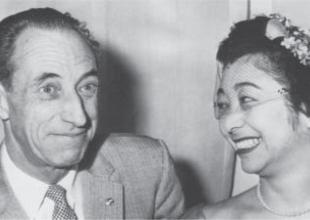
Noriko “Nikki” Sawada Bridges Flynn, former ILWU President Harry Bridges’ wife for the last 31 years of his life, died Feb. 7 at age 79 from complications of a chronic illness. But Nikki was much more than the spouse of a legendary labor leader—she was a civil rights activist and poet in her own right, an orator with quick wit and a sharp tongue.
We'd like to hear from you.
Phone line
Mon to Fri 8:00am-4:00pm
Working hours
451 Atkinson Dr
Honolulu, HI 96814
Honolulu, HI 96814
Visit us
Are you a new employee, hired within the last 12 months? If so, this issue of the Voice of the ILWU was prepared especially for you. As a union member, you are entitled to many rights and benefits and some responsibilities. This issue will help get you started with the essential information you need as a member of the ILWU. (Even longtime members may find the information useful.)
Higher wages, better benefits, and good working conditions are the most obvious advantages of being
organized in a union.
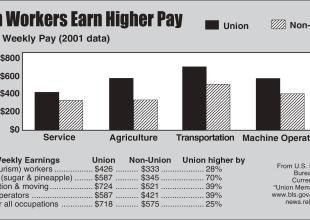
Based on data collected by the U.S. Department of Labor in September 2002, union workers earned an average weekly wage
of $788, while non-union workers earned 27 percent less, or $622 a week. The union advantage in wages alone is $166 a week. Figure 1 compares wages for union and non-union workers by occupation. The data is from 2001.
A third and very important benefit of union membership goes far beyond your job. You are now a member of a workers’ organization—dedicated to defend your interests as a worker and to promote the general welfare of you and your family.
This is spelled out in the ILWU Declaration of Principles:
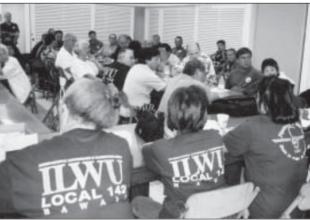
The letters I.L.W.U. stand for International Longshore and Warehouse Union, a union created in 1934 when longshore and
warehouse workers on the West Coast of the United States merged to form a single union. In 1937, longshore workers in Ha-
waii chose to join up with the ILWU, because it was a democratic union that stood for racial equality within its membership.
This was important to the Hawaii members who were mostly of Hawaiian and Asian ancestry.
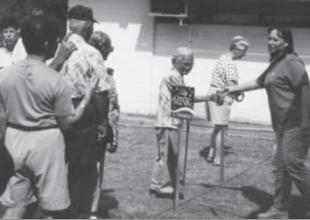
The ILWU Membership Services Program helps members get the most from the benefits provided by their union contract or by government and private agencies. This program is not limited to job-related problems, but will help members and their families with any problem they have, whether at home, in the community, or in school.
In the United States, an employee who does not have a union or any kind of agreement with their employer over job security, is considered an “at will” employee. This pretty much means all nonunion workers in private industry—or about 70 percent of U.S. workers—are at will.
An “at will” worker may be terminated by their employer at any time and for any or no reason. This means that a boss could wake up one morning and decide to fire the first employee he sees that day. As unfair as this may seem, it is perfectly legal under U.S. law.
The ILWU identified the 12 most important political issues which the union will focus on during the 2003 session of the Hawaii State Legislature. The issues deal with health care (1,2,9,10), workers rights and benefits (3,4,5,6,7), tax breaks for business (8), education (11), and working harbors (12).

This year, 2003, will be a busy year for ILWU democracy. There will be two major meetings (we call them conventions) where ILWU members will have the opportunity to set the policies and direction of their union.
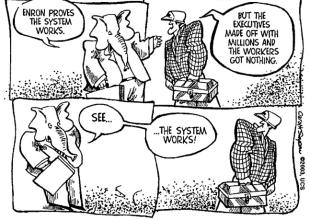
Economic stimulus vs. tax cuts for the rich
Both major political parties “say” something needs to be done to shore up the economy. The details of these plans clearly outline who the parties serve.